Introduction
A group of six stands in a Makkah hotel lobby at 6 a.m. Half want to climb Jabal al-Nour. The other half want the Hira Cultural District and an early lunch. That split is the planning problem this guide solves.
This guide is for families, older travelers, first-time visitors, and small groups deciding which optional ziyarat stops fit their time and energy.
It treats ziyarat as historical or cultural visits, separate from required Umrah rites, and it explains how pre-arranged transport for an agreed route works: you choose the stops, the pickup, and the return details, and the route is confirmed before you travel.
It is not a fixed sightseeing package. Two decisions follow from that. Which sites fit your group, and what to send for a route proposal.
Key Takeaways
- Ziyarat stops are optional historical or cultural visits, not required acts of Umrah
- Safa and Marwa are part of Sa’i inside Masjid al-Haram, not an additional transport stop
- Jabal al-Nour and Jabal Thawr involve real climbs; a cultural-district visit or an agreed viewpoint is a legitimate alternative
- The route is agreed with the traveler before the trip, with stops, pickup, and return details confirmed, not assumed
- Send your date, pickup area, group needs, and priority sites to receive a written route proposal
One distinction changed how I plan. I stopped adding Safa and Marwa to the transport list the afternoon a family asked why I had listed a rite they were about to walk inside the Haram; the list lost a familiar stop and the proposal got shorter and clearer. Keeping ritual walking separate from optional transport stops is the first filter for any group.
A written route proposal only helps if the service behind it is clear about pickup, stops, and return. The next section defines that service and draws the line between optional ziyarat and required rites, so you never confuse the two.
A Makkah ziyarat route shaped around your group
A tailored route only works if everyone agrees on what the service actually is. Before listing any sites, the boundary needs to be clear.
Explain what the transport service is, and is not
Pre-arranged transport means a pickup point, a route you selected, and a return time agreed in advance. It is not a fixed sightseeing package, and it does not include a religious guide.
A driver knows the roads and the practical realities of each stop; he is not there to interpret the historical or spiritual significance of what you visit.
Whether a stop suits your group depends on your preferences, the current access conditions, and how much walking each person can manage. No transport booking can guarantee entry to any site or universal suitability for every traveler.
Most first-time pilgrims assume the transport quote covers the climb. It rarely does. A client last Ramadan season asked me to book a route that included “Hira” as one stop, and when I asked how long he wanted at the base, he looked confused. He had pictured the driver parking at the cave itself. The conversation that followed took twenty minutes: the vehicle stops at the base of Jabal al-Nour, the Path to the Cave of Hira goes up from there, and the climb is his own effort, not part of any transport booking. Once he understood that, the route changed completely. He kept the cultural district visit, dropped the climb for his mother, and I added a viewpoint stop instead. That one clarification saved him from a very long afternoon with a very tired parent.
Expert Tip: A historical visit adds context and reflection, but it never completes, improves, or substitutes for a required act of worship.
Keep optional visits separate from Umrah rites
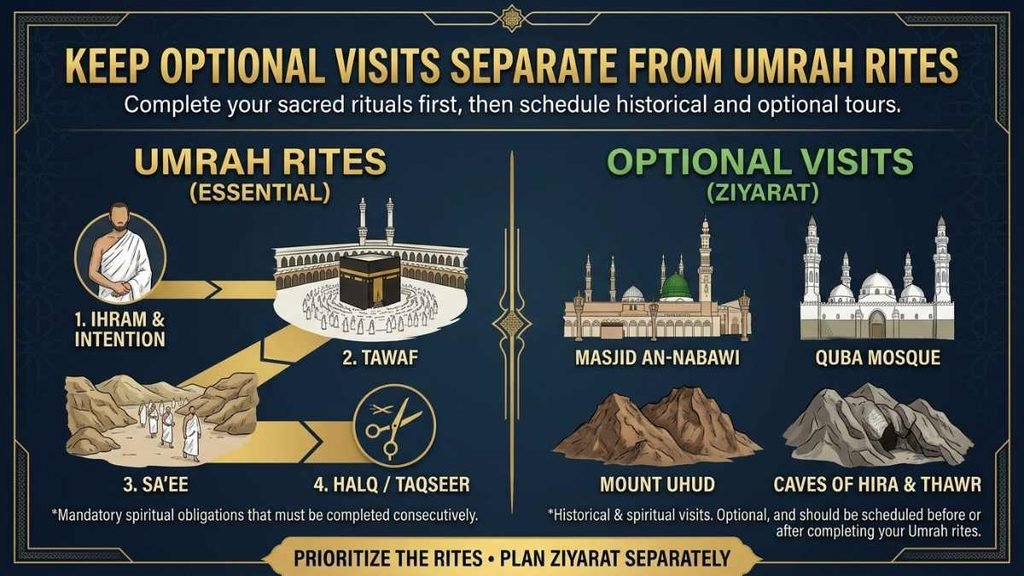
Ziyarat stops are optional historical and cultural visits. Safa and Marwa are inside Masjid al-Haram, and the walking between them is Sa’i, a core Umrah rite. No transport service takes you to Safa and Marwa as a sightseeing stop; you perform Sa’i yourself as part of your Umrah. Arafat and Masjid Nimrah are Hajj-associated locations, not Umrah rites, so visiting them during an Umrah trip is a separate, optional choice.
With the service boundary and the rite/visit distinction clear, the next step is deciding which sites actually fit your group.
Makkah sites to consider
Every site in this list is a ziyarat stop, an optional historical visit rather than a required Umrah rite, so treat what follows as a selection aid, not a must-visit itinerary. The aim is to weigh each site against your group before anyone commits to a route.
How do you know whether the mountain path suits your group? I start with one question: can everyone walk uphill for an hour without needing a rest? Across several bookings, the answer splits families cleanly. The ones who hesitate usually end up at the Hira Cultural District, browsing the museum and market while a younger member makes the climb. The ones who answer yes without pause tend to finish the path and still have energy for one more stop. That single question has saved more route planning than any site list I could hand over.
Compare purpose, effort, and booking questions
The table weighs historical association against likely effort, plus the questions worth asking before you commit. Nusuk’s directory entries describe history rather than current access, so treat the final column as your own checklist, not a promise from the directory.
| Makkah site | Why consider it | Visit type and likely effort | What to confirm before booking |
|---|---|---|---|
| Hira Cultural District and Path to the Cave of Hira | First revelation association; district offers museum and market at the base | District: low effort, cultural visit. Path: engineered but demanding climb | Confirm current museum and exhibition hours; confirm the path’s condition and your group’s walking tolerance |
| Jabal Thawr and Cave of Thawr | Refuge of the Prophet and Abu Bakr for three nights during the migration | Steep, rocky trail rated moderate to strenuous; return trip roughly 1.5 to 3 hours depending on fitness and crowding | Confirm trail condition and whether the group’s fitness matches the ascent |
| Al-Hudaybiya | Pledge of Ridwan and Treaty of Hudaybiyyah | Historical site visit, generally low physical effort | Confirm current access and what is open to visitors |
| Bay’ah Mosque Mina | Pledge of Aqabah | Short stop, low effort | Confirm access, especially during Hajj season when Mina is restricted |
| Masjid al-Jinn | Prophet’s encounter with jinn | Short stop, low effort | Confirm access and opening status |
Choose a Hira experience that matches the group
The Hira Cultural District and the Path to the Cave of Hira are two different decisions, and conflating them causes most of the planning mistakes I see. The district sits at the mountain’s base with a museum and market area. The path is an engineered climb up Mount Hira toward the cave, and it stays demanding despite the engineering.
Access to both the district and the path is listed as open 24 hours. Museum and exhibition hours are separate: as of June 2026, the Holy Quran Museum and Revelation Exhibition are open 24 hours except Fridays, when they close from 7 AM to 3:30 PM.
The Ministry of Hajj and Umrah notes that visiting the Cave of Hira is not one of the rulings of Hajj nor recommended, given the difficulty of reaching it, especially for the sick and elderly. Mount Al-Noor rises to roughly 634 meters about 4.8 km from Makkah. That figure matters more than any marketing photo. It is a real climb.
Expert Tip: Ask about walking tolerance before recommending the mountain path, and if the group prefers not to climb, discuss the cultural district or an agreed viewpoint and confirm its details before booking.
Help travelers decide which stops belong on their route
The decision rule is simple: start with the group’s priorities and energy, then agree the route. Do not reverse it by picking sites first and hoping the group keeps up.
For a shorter outing, pick one priority stop and build the route around it. A family with limited time might choose the Hira Cultural District for cultural learning without the climb, while a fitter group might commit to the path itself. Jabal Thawr’s steep, rocky trail, rated moderate to strenuous with uneven sections and limited handholds, is a separate commitment entirely and rarely belongs on the same day as the Hira path.
Product Recommendation: After the itinerary is agreed, provide a map link for each confirmed stop as a route reference rather than a live traffic estimate or a guarantee of journey time.
Those priorities carry straight into route design: family needs, mobility limits, and pace determine how many of these stops fit a single outing, which is what the next section works through.
A route that accounts for family, mobility, and pace
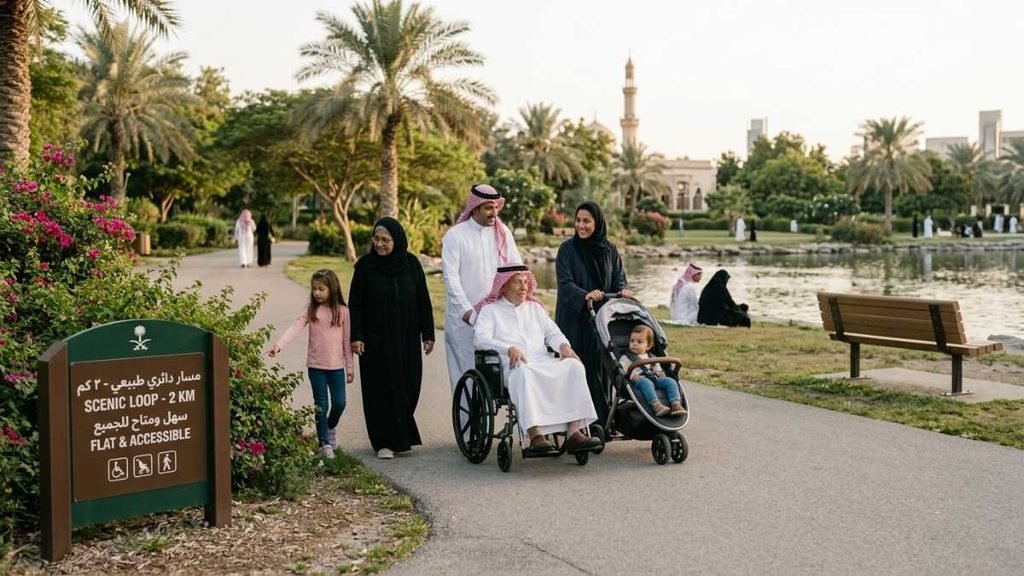
The sites are clear; now the route has to fit the people actually traveling. A fixed package assumes one pace and one set of legs. Your group probably has several.
Ask the right questions before suggesting a climb
Before any climb enters the conversation, ask who is actually traveling. Children tire differently from older adults, and a group that prays at set times needs rest stops and meal breaks built in, not squeezed around them. Ask about pace, and ask which sites matter most.
These questions shape the plan. They don’t guarantee access, because trail conditions and crowding change on the day.
Show the difference between a generic package and a considered plan
A generic package puts the whole family on the same mountain path. A considered plan starts with a conversation.
Picture the same family from the lobby scene above: the Cave of Hira is on their list, the teenage son wants the climb, and the grandmother would rather not wait alone. The planner separates the Hira Cultural District at the base, with its museum and market, from the demanding ascent, then writes both decisions down. The cultural stop is included. The climb is excluded.
That written itinerary is what separates an agreed route from a pressured one.
Expert Tip: If one person would rather not climb, don’t make the outing depend on the ascent: split the Hira Cultural District visit from the mountain path, agree an alternative, and write the decision into the itinerary.
Give the reader a simple itinerary selector
Use the documented effort cues as framing, not guarantees. Jabal al-Nour sits about 4.8 km from Makkah and rises to roughly 634 meters. Ghar Thawr’s steep, rocky trail runs moderate to strenuous, with uneven sections and limited handholds, and the return trip can take around 1.5 to 3 hours depending on fitness and crowding.
634 meters is the figure I’ve written beside Jabal al-Nour in every planning notebook for years, because once a group sees that elevation against the 4.8 km from Makkah, the climb-versus-cultural split stops being a debate and becomes a written decision.
The selector is a discussion aid, not a medical or accessibility assessment. Ask three questions: Who is traveling, and does anyone have limited mobility or pace? Which sites are priorities, and which are optional? Is anyone willing to climb, or should the cultural visit stand alone?
The decision rules follow: if mobility or pace varies, split cultural visits from climbs and agree alternatives; if priorities conflict, write the agreed stops and excluded climbs into the itinerary; if no one wants to climb, the Hira Cultural District still offers a museum and market at the base.
Worked example: a family of four with a grandmother who walks slowly and a teenage son who wants the climb. The selector splits the outing. The grandmother and one parent visit the Hira Cultural District, while the son and the other parent attempt the ascent only if conditions allow. The written itinerary records the cultural stop as agreed and the climb as conditional, not guaranteed.
When arranging the route, apply the transport checks: customer reviews for service quality, transparent pricing without hidden fees, vehicle quality for comfort, 24/7 support for unexpected changes, and driver experience on pilgrimage routes. These checks turn a written itinerary into a workable route.
From here, the visitor information and historical context below are grounded in sources readers can check themselves, starting with the Nusuk directory.
Visitor information and historical context you can trust
The route is planned; now make sure the visitor information behind it is sourced and scoped correctly. A directory entry can describe a site’s history without promising that the site is open, accessible, or right for your group.
Use sourced descriptions carefully
The historical and religious associations in this article follow the official Nusuk Makkah and Madinah directory. It identifies Jabal al-Nour and the Cave of Hira with the first revelation, Jabal Thawr with the three nights the Prophet and Abu Bakr took refuge there, and Al-Hudaybiya with the Pledge of Ridwan and the Treaty of Hudaybiyyah. The directory covers both holy cities, but the sites in this plan stay within Makkah. Those are historical descriptions, not access guarantees.
The museum doors were shut when the family arrived at ten on a Friday. I had sent them the Hira Cultural District page and repeated that the district and the Path to the Cave of Hira are open 24 hours, which is true, but I had not separated that from the museum and Revelation Exhibition schedule. The Friday closure window runs from 7 AM to 3:30 PM, and I had not flagged it. That window now sits in my daily itinerary checklist, right next to the Nusuk directory entries I use for site names. One line, and it has saved more than one group from standing outside a locked door.
Help readers use Hira’s schedule correctly
The official Hira Cultural District page lists the district and the Path to the Cave of Hira as open 24 hours.
The Holy Quran Museum and the Revelation Exhibition follow a separate schedule: as of June 2026 they are open 24 hours a day, except on Fridays when they close from 7 AM to 3:30 PM.
The earlier day-specific hours have been expanded, with Friday remaining the only closure window. Confirm the schedule for the date you plan to visit before travel.
With that sourced context in place, the next step is turning the chosen visits into a clear inquiry and confirming only what the provider has agreed to.
How to request and confirm a tailored trip

Everything above leads to one action: requesting and confirming a route that fits your group, not a package that fits everyone.
At a colleague’s pre-Ramadan planning session, I watched him send an inquiry that said only “ziyarat transport, please quote.” The provider replied with a package list, no route, no price. The setting that clicked was the group size: once he added “five passengers, two elderly, pickup near the Haram on Thursday,” the provider returned a written route, a van that fit all five with luggage, a total price, and a cancellation window. That one clarified parameter turned a brochure into a confirmable offer.
Present a clear proposed booking offer
When the reply arrives, compare it line by line with your request. Does the proposed route match your destination list? Does the timing fit your prayer and rest needs? Does the vehicle fit every passenger and their luggage? Check the total price, what it includes, and the cancellation terms. If anything differs, ask for a change and get the revised offer in writing before you accept.
A sample inquiry you can adapt
Send something like this:
Date: [preferred date] Pickup area: [hotel or area near the Haram] Sites: [list your preferred Makkah sites] Duration: [half day or full day] Passengers: [number], including [elderly, children, or mobility needs] Please send a written route, timing, vehicle fit, total price, inclusions, and cancellation terms.
A package listing is not a confirmation of your specific route or access. Keep asking follow-up questions until the written reply matches your group.
Make the service boundary and next step plain
Ask plainly whether the provider offers transport only or can separately arrange a qualified guide. Transport is not religious guidance, and no driver’s reply should imply guaranteed site entry.