
Introduction
You land at JED, open a ride app, and search for a taxi. The word feels simple until the options load and none of them say “taxi.” That moment is where most Jeddah transport confusion starts, because “taxi” here can mean an app ride, a conventional taxi, or a prebooked transfer, and each differs in pickup, route, and fare terms.
Key Takeaways
- ‘Taxi’ in Jeddah can mean an app ride, a conventional taxi, or a prebooked transfer. Uber offers no taxi rides to or from JED, only ride-hailing options.
- Match the ride type to the trip: an app for an immediate city ride, a prebooked provider for a specified airport handoff or longer route, and a confirmed larger vehicle for groups and luggage.
- Compare quotes on identical journey details, and treat an app’s upfront estimate as adjustable if surcharges or tolls differ.
- Confirm the airport meeting point, delay and waiting terms, and exact vehicle fit before comparing headline fares.
- No provider is ‘best’ for everyone. The right choice depends on urgency, route, group size, luggage, and pickup certainty.
Uber’s own JED page states it plainly: taxis are not available for airport rides to or from JED.
What you get instead are ride-hailing options with upfront pricing that may be adjusted at the end of the trip if surcharges or tolls differ. Standing at the JED arrivals curb, I opened the app expecting a taxi option and found none, only ride-hailing choices; that was the moment I stopped ranking providers and started matching ride type to trip, losing the comfort of a single “best” and gaining a way to spot a fare that hid an unresolved handoff.
This guide is a decision path rather than a provider ranking, for anyone landing at JED or moving through the city. Match the ride type to your trip first, then compare quotes. Confirm pickup, waiting, and vehicle-fit terms before you land, so a lower headline fare cannot hide an unresolved handoff.
Before comparing providers, settle which kind of ride your trip actually needs.
Start with the kind of ride you need

First, choose the right category of ride. The brand can wait. “Taxi” covers three arrangements that differ on route, pickup, and fare terms, and picking the wrong category is what turns a cheap quote into a bad trip.
What “taxi service” means in this guide
App-based ride-hailing is a ride requested through an app with a live quote and in-app trip information. A taxi is a conventional taxi, and a ride-hailing app’s taxi service is not the same as its ride-hailing service. A prebooked private transfer is a vehicle arranged in advance for a specified pickup, route, or group. Travelers use “taxi” broadly, so this guide compares all three without claiming one provider is best for every trip.
Quick decision summary by trip type
Trip type is the first filter, and no category wins everywhere.
- Immediate city rides favor app-based ride-hailing: the quoted fare is live and the car is already nearby.
- JED pickups split on handoff terms. Some options confirm a meeting point; others leave you to find the driver.
- Larger parties turn on vehicle fit. Count passengers and bags, then match the vehicle to the count.
- Journeys beyond Jeddah change the fare basis and route. Confirm both before booking.
Before you choose, know your pickup point, your passenger-and-bag count, and whether the trip stays in Jeddah.
A quick trip-fit selector
Four questions sort most trips:
- Immediate or scheduled?
- JED pickup or city pickup?
- How many passengers and bags?
- Within Jeddah or farther?
Each answer narrows which terms matter. Scheduled, JED pickup, three passengers with bags, within Jeddah: ask whether the vehicle fits three bags and where the meeting point is. The selector names decision points, not availability, pricing, or a provider ranking.
The cheap quote rarely survives contact with actual luggage. A neighbor heading to JED for a flight home booked the smallest app ride because the fare looked right, then stood at the curb with three suitcases and a carry-on. The trunk took two. The rest rode on laps. Uber sizes its UberX option for about two suitcases, and that is a design fact, not a suggestion. It is the first thing I check before comparing any quote.
With the ride type clear, the next step is to look at the specific options side by side.
Compare the available options without treating them as a ranking
Once you know the ride type, compare the named options on what their sources actually say. These are shortlist candidates, not a performance ranking: their route descriptions, vehicle details, and booking paths differ.
Service and provider comparison
| Option and category | Routes or use cases described in source | Booking method or contact route shown | Fare basis and inclusions confirmed? | Vehicle and group fit confirmed? | Pickup, delay, and support terms confirmed? | Best-fit reader scenario | Source and checking date |
|---|---|---|---|---|---|---|---|
| Uber ride options (app-based ride-hailing, not an airport taxi) | JED rides; UberX, UberXL, and UberXL Intercity | Uber app; Uber Reserve can be booked up to 90 days ahead | Upfront pricing is shown; inclusions not confirmed – verify | UberX holds about 2 suitcases and UberXL about 3; passenger capacity not confirmed – verify | Not confirmed – verify. Uber says its taxi service is unavailable for rides to or from JED | A city ride or an app-requested ride where the available vehicle option fits | Uber JED page; checked October 15, 2026 |
| Haramain Cabs (prebooked airport and pilgrimage transfer) | Jeddah Airport, Makkah, Madinah, Taif, train stations, hotels, and Ziyarat | Website; phone contact shown on fleet page | Not confirmed – verify | Sonata: 3 seats / 3 medium bags; Staria: 7 seats, but baggage entries conflict at 3 and 10 medium bags. HIACE: 10 seats / 10 medium bags; Coaster: 23 seats | Not confirmed – verify | A traveler comparing a prebooked airport, hotel, or pilgrimage transfer | Haramain Cabs homepage and fleet page; checked October 15, 2026 |
| Al Fateh Transport (prebooked private and group transport) | Airport, Umrah, corporate, and group transport | Website; its booking guidance also describes website or WhatsApp contact | Not confirmed – verify | Sedan: 3 people / 3 luggage. Staria: 7 people; baggage is listed as 10 on the fleet page and 12 on the packages page | Not confirmed – verify | A small party or group looking at a prebooked private transfer | Al Fateh Transport homepage, fleet, packages, and booking guidance; checked October 15, 2026 |
What the listed routes and fleet descriptions do, and do not, tell you
A route list helps identify whom to contact. It does not promise a vehicle for your date, time, or exact pickup. Treat published capacities as a starting point, especially where the same provider’s pages give different baggage figures.
Would I choose a JED-to-Makkah transfer from the route list alone? No. I would ask for the exact vehicle and confirm the meeting point before landing, then compare the answer with the party’s bags. When a fleet page gives conflicting Staria baggage figures, that clarification can matter more than a broad claim to serve the route.
Confirm the exact vehicle, room for passengers and bags, and whether child seats, mobility equipment, or accessibility needs can be accommodated. A seat count alone does not establish that a vehicle suits every passenger or item.
Expert Tip: Before comparing quotes, ask whether the amount is per vehicle or per passenger, what it includes, and how extra stops, waiting, tolls, and destination changes are handled.
Separate a city ride, airport pickup, and intercity transfer
For a short city ride, check the available ride option and its fit for the immediate trip. An airport pickup needs a confirmed meeting point and a clear plan for flight delays; ask directly whether flight tracking is included. For an intercity transfer, confirm the route, vehicle, passenger and luggage fit, and the quoted fare for that journey.
These are different booking tasks. A short in-city quote and a long-distance transfer quote are not equivalent comparisons, even if both show one total.
A shortlist only helps once you compare quotes on identical terms.
Compare quotes on the same terms
Comparing providers means little until every quote answers the same questions. A cheaper figure can still leave the pickup or waiting arrangement unsettled.
The quote checklist
Give each provider the same pickup and drop-off points, date and time, passenger count, luggage count, and requested waiting allowance. Then ask for the quoted fare, and whether it is per vehicle or per passenger.
About SAR 71 is Uber’s stated average UberX fare from JED; when I set that beside a private-transfer quote, I would treat it as a reference, not a verdict, since Uber says its upfront estimate may change at trip end if tolls or surcharges differ.
Use one worksheet for every option:
| Quoted total | Pickup arrangement | Waiting terms | Unresolved issues | Your priority |
|---|---|---|---|---|
Completed hypothetical quote decision
The figures and terms below are hypothetical. Both providers are quoting the same journey; Option A has not clarified waiting or the pickup arrangement.
| Hypothetical option | Quoted total | Pickup arrangement | Waiting terms | Unresolved issue | Reader priority | Decision |
|---|---|---|---|---|---|---|
| A | 220 SAR | Not specified | Unresolved | Pickup arrangement and waiting allowance | Know who is meeting me and how long they will wait | Hold pending clarification |
| B | 250 SAR | Confirmed | Confirmed | None for this comparison | A clear handoff and waiting arrangement | Choose B |
Option B costs 30 SAR more: 250 minus 220. That difference is not the deciding factor here. Compare price and terms together, then decide whether the cheaper quote still fits your priorities once its gaps are answered.
A practical quote-clarity scorecard
Print or copy this for each quote. Score each item 0 for unclear, 1 for partly clear, or 2 for clear: same journey details; quoted total; pickup arrangement; waiting terms; vehicle fit for passengers and luggage. Maximum: 10.
For hypothetical Option A: 2 + 2 + 0 + 0 + 2 = 6/10. This is a clarity score, not a safety rating. The missing answers are: Where exactly is pickup arranged, and what waiting allowance applies?
For airport arrivals, the quote is only half the story. The handoff plan matters just as much.
Plan the airport handoff before you land
A quoted fare only helps if you know how to find and contact your ride at the airport.
The fare was locked, the car confirmed, and I still spent twenty minutes circling the arrivals hall looking for my driver. The booking had settled the price and the vehicle, but the meeting point in my confirmation just said “arrivals,” which covered three different pickup zones. The fare was settled. The handoff was not.
Airport pickup checklist
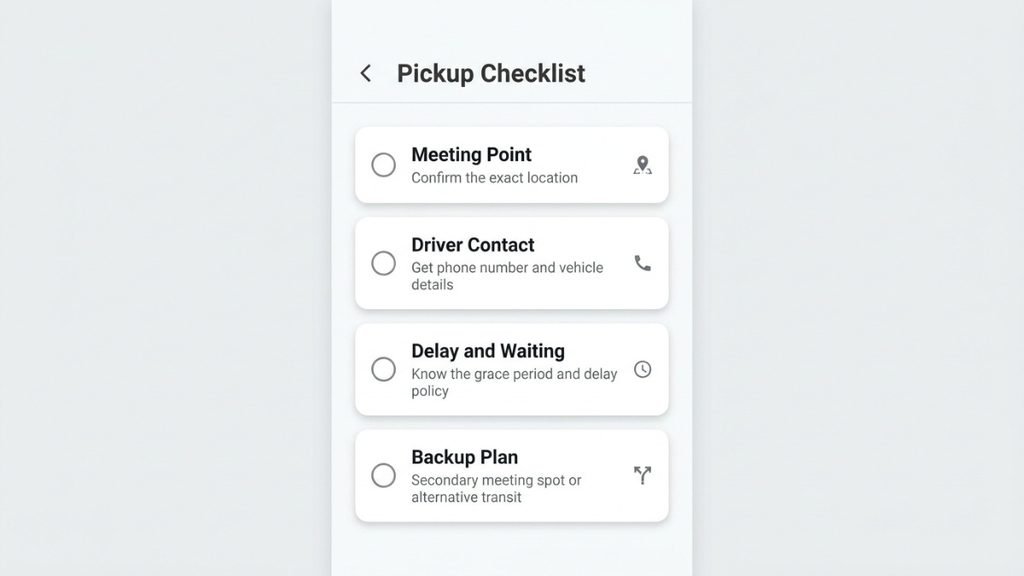
Before you fly, ask the service four things: the exact meeting point, how the driver will contact you, what happens if your flight lands late, and what to do if you cannot find each other. Providers differ on all four, so don’t assume one policy applies across JED.
Arrival-day handoff mini-case
Picture a family of four landing at JED with three suitcases. Their pre-booked transfer told them to exit at door 3, expect a driver holding a name sign, and use a WhatsApp number as backup. Now picture the same family with a vague “we’ll meet you at arrivals” promise, scanning a crowd of drivers. The difference between those two landings is whether the handoff has a plan.
Once the handoff is planned, run a few trust and currency checks before paying or boarding.
Check trust, safety, and current terms
Even a well-matched ride deserves a final check on trust, safety, and current terms.
Questions to ask before paying or boarding
Confirm the driver, vehicle, and pickup point through the same channel used for booking, before any money changes hands. Save the quoted fare and any waiting or cancellation terms as a dispute reference.
During a client’s Umrah transfer last Ramadan, I watched a colleague quote the airport-to-Makkah leg from a third-party range and pay without checking the Transport General Authority’s policy page. The driver asked for more at the curb, and there was no saved confirmation to push back with. That is why I now keep the quoted fare and the official page open in the same tab before payment.[exp end]
For the current official framework, check the Transport General Authority’s fare-policy page, last updated 28 July 2025, rather than third-party fare ranges. Provider marketing pages and indicative ranges stay unverified until you match them against that policy or a live quote.
What this guide can responsibly recommend
No guide can verify every provider’s current terms, so this one recommends by use case rather than a blanket “best” claim. A prebooked private transfer suits a fixed pickup with luggage; an app-based ride-hailing trip suits a flexible departure.
With the checks done, make the final choice by fit.
Make the final choice by fit, not by a blanket “best” claim
All the comparison work leads to one decision: which option fits your trip. A lower headline fare means nothing if the pickup terms are still unresolved, so weigh fit first and price second.
A final pre-booking checklist
Before you book, confirm each of these:
- Service type and route, stated in writing
- Identical-journey quotes, so you’re comparing like with like
- Vehicle fit for your passengers and bags
- Airport handoff terms: meeting point, waiting time, and driver contact
- Intercity route acceptance, if your trip leaves Jeddah
- A confirmation you can actually reach when you need it
“Which one’s cheapest?” a client asked, and across a dozen bookings the answer never changed. The fare that mattered was the one with vehicle fit and pickup terms already confirmed, not the lowest number.
Closing recommendation and call to action
No single service wins on every trip. The right ride is the one whose pickup, waiting, and vehicle-fit terms you can verify before you land. Work through the checklist above, get written answers to anything still open, and book the option that fits your journey.